
Soils 101: Understanding the Foundation of a Healthy Lawn
Healthy turf starts with healthy soil. You can apply the best fertilizers, follow perfect mowing practices, and water consistently, but if your soil structure is poor, the turf will always struggle to perform. This guide breaks down the basics of soil science in a clear, homeowner-friendly way — so you can better understand how your lawn behaves and what it needs.
⚙️ The Basics of Soil: Sand, Silt, and Clay
Soil is made up of three primary particle sizes:
1. Sand – The Largest Particles
Gritty texture
Drains very quickly
Low nutrient-holding capacity
Warms up fast in spring
Easy for roots to grow through
Lawns in sandy soils often struggle with nutrient retention and require more frequent, lighter fertilizer applications.
2. Silt – Medium-Sized Particles
Soft, flour-like texture
Holds more moisture than sand but drains better than clay
Moderately fertile
Good balance for turf growth
Silt is generally the most favorable soil particle for cool-season grasses because it supports consistent moisture and nutrient levels.
3. Clay – The Smallest Particles
Sticky when wet, hard when dry
Holds water extremely well
Very high nutrient retention
Slow drainage and poor aeration
Clay-heavy soils can cause compaction, standing water, shallow rooting, and susceptibility to disease. These soils benefit most from consistent aeration and organic matter amendments.
🧪 Understanding Soil Texture: How These Particles Mix
Soil texture is determined by the percentage of sand, silt, and clay in your soil. Together, these combinations form different soil classes, such as:
Sandy loam
Loam
Silt loam
Clay loam
Silty clay
Loam — a blend of sand, silt, and clay — is often considered ideal because it offers the best balance of drainage, fertility, and root support.
Below is a visual reference of the USDA soil textural triangle, which is used to classify soil types:
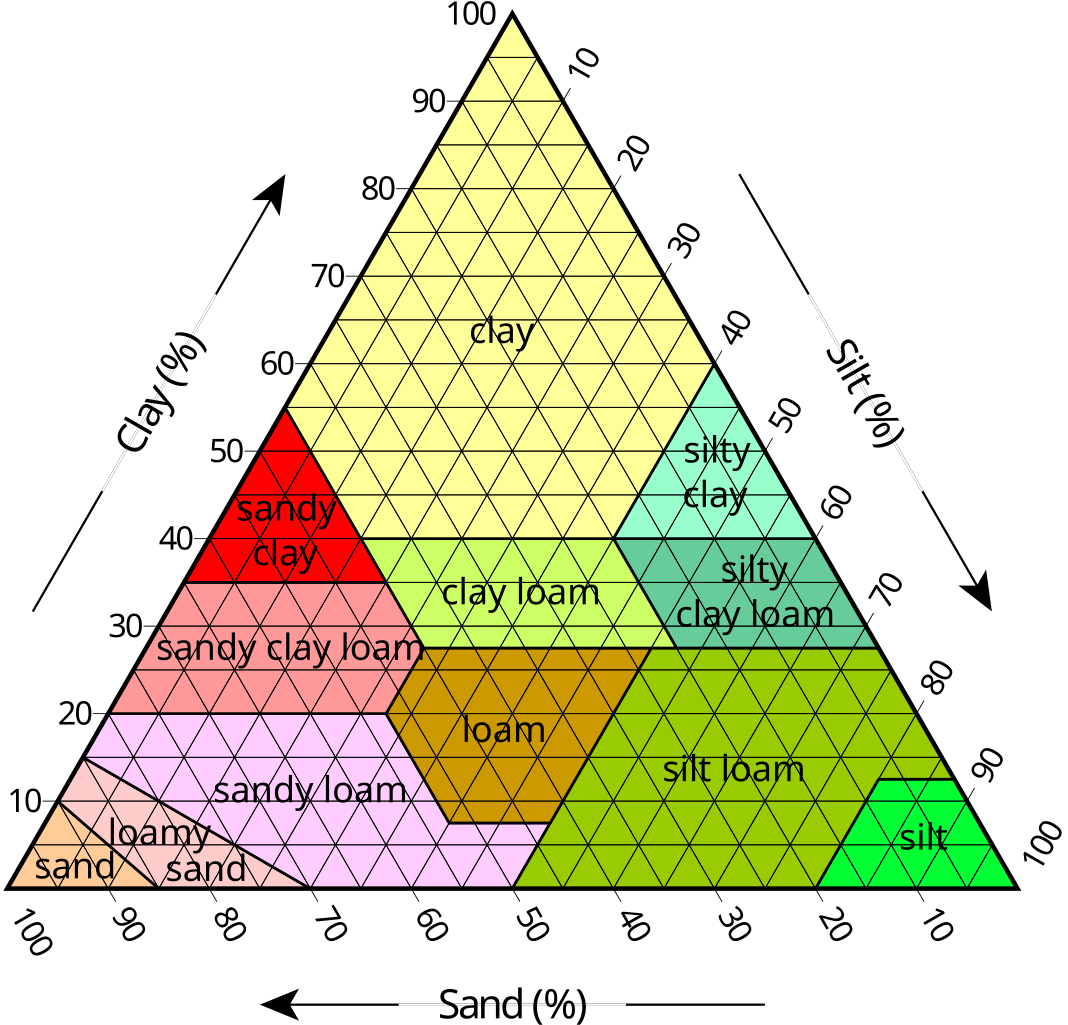
Understanding where your soil falls within this triangle helps determine:
Water-holding capacity
Fertility and nutrient retention
How often to fertilize
How to adjust mowing or irrigation
Whether aeration or amendments will be effective
🌾 Why Soil Texture Matters for Cool-Season Lawns
Cool-season grasses (Kentucky bluegrass, perennial ryegrass, tall fescue) thrive when soil texture supports:
Deep rooting
Consistent moisture
Good air exchange
Moderate fertility
Proper drainage
Sandy soils
→ Need more organic matter and frequent fertilization.
Clay soils
→ Need aeration, gypsum (if sodium is an issue), and careful watering.
Loamy soils
→ Require the least corrective work.
Knowing your soil texture helps you stop guessing and start making intentional, scientifically supported decisions.
🌍 Using the USDA Web Soil Survey: A Simple Guide for Homeowners
The USDA Web Soil Survey (WSS) is one of the most useful — but most intimidating — tools for understanding your soil. This guide will walk you through the basic steps.
🔗 Web Soil Survey:
https://websoilsurvey.sc.egov.usda.gov/
🧭 Step-by-Step Guide to the Web Soil Survey
1. Open the Site and Click “Start WSS”
This loads the interactive soil map.
2. Locate Your Property
Use one of the following options:
Address search
Zoom manually on the map
Lat/long coordinates
Once you find your property, zoom in until you can clearly see your lawn area.
3. Define Your Area of Interest (AOI)
At the top of the map, select:
AOI Rectangle tool or
AOI Polygon tool
Draw over your property or lawn area.
When the AOI loads, the site will outline your selection in blue.
4. View Soil Map Units
After selecting your AOI, the site automatically lists:
Soil series (names like “Minoa silt loam” or “Mahoning sandy loam”)
Percent slopes
Drainage class
Key limitations
These descriptions help predict:
Drainage issues
Compaction potential
Suitability for turf
Fertility potential
Erosion risk
5. Explore the “Soil Data Explorer” Tab
This is where most of the useful information lives.
Look for:
Soil Physical Properties (important for irrigation + compaction)
Organic Matter Estimates
Available Water Capacity
Soil Texture and Composition
pH and Chemistry (inferred, not lab-tested)
This data helps you understand how your soil will respond to watering, mowing, fertilizing, and aeration.
6. Print or Save Your AOI Report
You can export a free PDF report that summarizes all soil map units and their properties.
Adding this to your lawn folder helps with:
Fertilizer planning
Irrigation adjustments
Long-term soil improvement strategies
🌱 Why Web Soil Survey Matters
Most homeowners never look past the surface.
But understanding:
Soil texture
Drainage class
Organic matter potential
Compaction tendencies
Water-holding capacity
…gives you a clear roadmap for why your lawn behaves the way it does.
This is the foundation that makes every fertilizer application, mower adjustment, and irrigation schedule more effective.
